Wednesday, August 30, 2006

The Book Scandal Strikes Back

And this time it's a real writer who's under the gun: Günter Grass, Nobel Prize-winner. I'm not going to say much about this other than to remark that these book scandals seem to be getting more serious. Next thing we know, Charles Darwin will be accused of having rigged Origin of the Species.

Seriously, though, we're getting closer to a potential carthsis this time. The betrayal represented by Mr. Grass, his memoir, and its revelation that he was once a member of the Waffen-S.S. is far closer to the sort of massive, international political treachery that I believe these scandals are sublimating.

For me the big question that remains is what the skepticism of Grass (as well as less distinguished authors like James Frey) implies about our contemporary attitude toward truth. There seems to be a growing sense that, in every arena, those who have been appointed to articulate our collective truth are somehow dishonest -- not only with us, but (perhaps even more imporatantly) with themselves. Is this what these scandals are trying to say, to articulate our shared sense of denial? Is that why we haven't yet been able to collectively express our outrage at the Bush administration? Because too many of us still can't admit that things actually are as bad as they seem...

Labels: ,

Monday, May 15, 2006

Unbinding the Universal Library: A Response to "Scan This Book!"

Now that my good friend Mr. WD has made a more formal critique of my last post, I should admit that -- in that case, at least -- my sweeping tone and will to generalize were perhaps a little excessive. I have a tendency to conflate certain idea-connections that seem obvious in my head but lack a genuine basis in the real world -- which is why I always reserve the right to revise myself. I agree with Mr. WD's suggestion that television holds the primary responsibility for our lowered attention spans and the current situation in which "publications that feature thoughtful, challenging, multi-page essays have seen a precipitous decline," as well as his conclusion: "If it is indeed the case that Americans' attention spans are significantly lower than they were 50 years ago . . . then it is incumbent upon us overeducated leftists to get better at 21st century 'message crafting.'" Nevertheless, I can't help voicing a few reservations as we plunge headlong into the sea of sound bites.

Allow me to refer to the article I mentioned in yesterday's comments section: "Scan This Book!" by Kevin Kelly, currently the most e-mailed article on NYTimes.com. The article focuses on Google's endeavor to scan the books of five research libraries to make their contents searchable online and the idea of a so-called universal library that will contain in one place a record of all human knowledge, past and present. Every book, every article, every painting, photograph, film, piece of music, web page -- all of it "fully digitized" on 50 petabyte hard disks. "Today you need a building about the size of a small-town library to house 50 petabytes. With tomorrow's technology, it will all fit onto your iPod. When that happens, the library of all libraries will ride in your purse or wallet -- if it doesn't plug directly into your brain with thin white cords."

I'm put off by the tenor of this article; by its unrelentingly optimistic view that the creation of such a library is not only inevitable, but inevitably good. First of all, I don't necessarily believe it can be done (or at least done as well as Kelly envisions it). Kelly spends much of the second half of the article detailing the numerous copyright-oriented obstacles that stand in the way of completing the book digitization process, but never doubts the final inescapability of that digitization. He refers to the Great Library of Alexandria as the predecessor to his universal library, as if to suggest it can be -- and has already been -- done, but makes nothing of the fact that we remember the library of Alexandria primarily for the fact that it burned down. Its place in our collective imagination is as an embodiment of lost knowledge. Am I the only one left with any qualms about putting all our intellectual eggs into one digital basket, so to speak? I can't help feeling unsettled by the idea that the best way for us to store information is no longer in the form of an accumulation of bound volumes, but rather a single stream of 1s and 0s that reside on a server (or servers) owned by Google. (Kelly hasn't advocated for getting rid of our paper libraries, but he implies that regular books are inherently limited and delights in listing the seemingly unlimited benefits of his own universal library.)

In point of fact, the notion of achieving unlimited knowledge is one fraught with a series of deep, mythical reservations: think Faust or Prometheus. I am reminded of the men in Gabriel Garcia Marquez's "One Hundred Years of Solitude," who invest the better part of their lives trying to decipher a series of nearly magical, knowledge-bearing parchments -- a quest that succeeds, but ultimately dooms the lineage of these men and their civilization forever (**Spoiler Alert: these are the last two and a half sentences of the book!**):

" . . . [Aureliano] began to decipher the instant that he was living, deciphering it as he lived it, prophesying himself in the act of deciphering the last page of the parchments, as if he were looking into a speaking mirror. Then he skipped again to anticipate the predictions and ascertain the date and circumstances of his death. Before reaching the final line, however, he had already understood that he would never leave the room, for it was foreseen that the city of mirrors (or mirages) would be wiped out by the wind and exiled from the memory of men at the precise moment when Aureliano Babilonia would finish deciphering the parchments, and that everything written on them was unrepeatable since time immemorial and forever more, because races condemned to one hundred years of solitude did not have a second opportunity on earth."

The Internet is this city of mirrors (or mirages): an interconnected series of words and images -- not of objects, but of reflections of objects and reflections of reflections of objects. The digital age, as Kelly suggests, is one in which we are so glutted with copies of objects that finally the copies no longer have any value. This is more than a threat to current business models (Kelly's idea), it suggests that we have embarked upon an entirely new form of perception -- one that no longer relies on observations of the world, but on a rearrangement and resorting of those observations of the world that have already been documented. Perhaps this is what I was getting at in my last post when I referred to a "growing mistrust of facts" . . . television and the Internet are less interested in coming to an understanding of the world than in creating a dazzling manipulation of that world by means of the screen and a series of refracted, electronically beamed lights. I can't help wondering whether, if we continue on this trajectory, the twenty-first century will finally lose touch with reality to such an extent that it winds up like Marquez's Macondo: wiped out by the wind and exiled from the memory of men.


Stay Tuned: Next time (probably Wednesday) I will continue my discussion of this article by looking at the potential drawbacks to Kelly's plans for linking, tagging, and weaving books into the web.

Labels: ,

Friday, May 12, 2006

To the New Age of the Unprinted Word, or, Kaavya Viswanathan: Scapegoat of Truthiness, Part II

I HAVE DELETED MOST OF THE CONTENT FROM THIS POST BECAUSE IT WAS A BAD POST. I HAVE LEFT A FEW WORDS BELOW BECAUSE THEY AREN'T AS BAD AS THE OTHERS.

My only guess as to what will (and already is) filling the print media void is the Internet, and I honestly don't know whether this is an ominous premonition of a new-dawning era of rampant hearsay and vacant chatter or whether I should feel hopeful that maybe the bloggers will pull a few of the punches the Corporate Media isn't up for. In either case, here's to the impending Age of the Unprinted Word.

Labels: ,

Friday, February 03, 2006

James Frey: Scapegoat of Truthiness

I haven't read A Million Little Pieces, but my girlfriend has read it and everyone knows this is basically the same thing. I can therefore assure you it is bad book. A cellophane-wrapped piece of mint candy that will freshen your breath and tell you in a predictable and simpleminded manner how to tough out rehab and thus be forgiven for all the nasty things you did when you were a drunken drug addict. So what. Some people are unredeemable. Most apologies are insincere. How do you explain that in twelve steps? If you want a more thorough analysis of the book, read Janet Maslin's review. I'm much more interested in the controversy than the book. The controversy is a hundred times more interesting than the book. Each day I am dumbfounded by the attention being given to this silly piece of mint candy literature, delighted at the foul taste left in the mouths of the American reading public by this breath freshener gone bad. Because now the American reader can no longer avoid the foul taste that has been there all along and must acknowledge the dubious motives and supreme artificialities fueling the current, plastic infatuation with memoir-ish writing and other various insipid chronicles of harrowing adventure and True Life heroism. Now that the American readers have begun to choke on one of these proven-effective bad-breath-eliminators, this 430-page box of Altoids ("curiously strong" at first, but after a while you get used to it) ... well, gee, it sure seems like someone should be held responsible. My feeling, though, is that this controversy doesn’t really have that much to do with James Frey or even his book because this is about Americans feeling betrayed and victimized within every level of their lives, by everyone they are supposed to trust. Our parents lie to us when we are little and our teachers lie to us at school. Once we are adults we find the institutions into which we have been taught to invest our faith are at root foul and devious. Our priests lie to us and our preachers lie to us. Our President lies to us. Even our nonfiction authors lie to us! The American story is filled with nothing but treachery and deceit. Mr. Frey’s story, then, which is about self-victimization and the possibility of transcending self-victimization, is actually a fairly appropriate forum in which to explore this collective anxiety. For who else can we blame for the rotten state of the economy, the terrible, endless wars we've started in Iraq and Afghanistan, the lack of equitable health care, the abundance of crooked politicians, the vast disparity of wealth and resources -- who else can we blame for this but ourselves?

Apparently we can blame James Frey.

This is sick. I am profoundly troubled that the only public person in this country with any conviction is apparently Oprah, as misplaced and shortsighted as her conviction is. At least she's standing up to someone, even if it's not the people with actual power. When will Americans wake up? What bizarre form of narcotic has lulled this country into such an unrelenting state of oblivion? Is this the work of television? Of pulp fiction? Should some of the blame be pinned on James Frey and the other writers of mint lozenge literature? The only thing that made James Frey's book interesting or in any way distinguishable from the next rehab memoir was the outrageous nature of its details. To find out that those details were exaggerated, then, that James Frey did not, in fact, experience extreme dental surgery, but instead intentionally distorted his memory in order to create a better story and sell more books -- this, of course, undermines the very foundation of that book. Some readers don't think so, but they are naïve. They are the most persistent of the many sleepwalkers among us. Look! Look at them stumbling all over Oprah's message board, standing by James Frey, mumbling in this or that way that the ends justify the means. Mr. Frey has also tried to defend himself, but I can't really blame him for that. Poor man isn't very clever, though, and when he appeared on Oprah to try and explain his confused distinction between the "essential truth" and the actual truth of his own life, he just sounded pathetic. The distinction he was attempting, of course, is a valid one -- though clearly he wasn't up for its challenge. For thousands of years humanity has been trying to determine the nature of truth, and Mr. Frey figured he could just blurt it out on a talk show? At least he got one thing right. His idea about having to create a character, a tough-guy protagonist that was really just a "coping mechanism" to avoid dealing with the cruel, overwhelming nature of his addiction -- this is really spot on. That's just the sort of thinking a real memoir writer does before he writes his book. Then, in his book, he deals with the consequences of that character and attempts to answer the difficult questions that that character implies. For instance: Between the spectacular, imagined identity and the messier, less heroic but factual identity, where does the real James Frey exist -- and what form of madness could have possibly caused such a schizophrenic invention in the first place? Where, after all, are the borders of sanity when beset by affliction? To what limits will the mind go to avoid self-destruction?
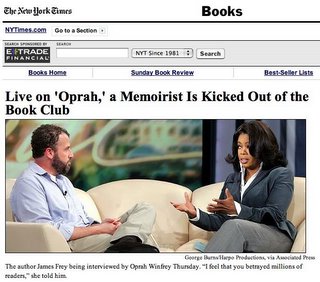
Now that sounds like an interesting book.


*The New York Times has given an unusual amount of coverage to this scandal. I have yet, however, to read anyone draw out the parallel between James Frey and the White House, so as I have suggested, and as I will now restate: I believe there is a deep psychological connection between the sense of betrayal caused by James Frey's book fabrications and the far more problematic, harder-to-express sense of betrayal regarding the fabrications of our political leaders.*

This is The Times' dramatic rendering of the televised Oprah v. Frey showdown.

This is an approach to the ethics of writing a memoir.

Here is the Times' official editorial stance.

Mr. Frey's book sales are dipping.

***Note: This piece by Michiko Kakutani, "Bending the Truth in a Million Little Ways," touches on the parallel I've been trying to make here. It is a short but helpful glimpse at contemporary literature and "the truth."

Labels: , ,